
Micro and Swiss-type machining solve a problem ordinary CNC turning struggles with: producing very small, often slender parts — shafts, pins, sleeves, connector contacts — without the part deflecting or drifting out of tolerance mid-cut. If you're trying to work out whether your part actually needs that process, or just looks small on the drawing, here is what happens at each step, from bar stock through machining, collection, and optical inspection.
Small parts fail differently than large ones — material support, handling, and measurement all matter more, not less, as diameter shrinks. Our micro-machining cell is built around exactly that: back-spindle completion in a single setup, continuous unattended running, and optical measurement fine enough to verify features you cannot check with hand tools.
01
When You Need Swiss-Type Machining, Not Standard Turning

These are the kind of parts this process exists for: brass connector contacts, a few millimeters long, each with stepped diameters, a chamfered nose, a knurled band, and a bore running through the middle. Every one of those features has to be concentric with the others on a part small enough to sit comfortably on a fingertip.
In this article, Swiss screw machining means CNC Swiss-type machining on a sliding-headstock lathe. Buyers also call this process Swiss-type turning or sliding head turning; the broader term screw machining alone does not identify a particular machine configuration. A Swiss-type, or sliding-headstock, lathe feeds bar stock through a guide bushing positioned right next to the cutting tool, instead of leaving several inches of it unsupported off a standard chuck. That support is the whole point: it keeps a few millimeters of bar from flexing under cutting force the way it would on a conventional lathe.
The smaller the part, the more that support matters. A pin only a few millimeters in diameter has very little stiffness of its own — the margin between a good part and a bent or out-of-round one shrinks faster than the tolerance does. That is the actual test for whether a part needs this process: not whether it looks small, but whether its stiffness during cutting can still be trusted to a standard chuck. If a feature would flex, chatter, or drift out of round held conventionally, that is what Swiss-type support solves.
- Micro shafts and pins
- Sleeves, inserts and bushings
- Connector and terminal contacts
- Small threaded or stepped components
02
It Starts with the Material

Every bar on this rack is tagged by grade before it reaches a machine — C3604 brass alongside stainless, carbon steel, aluminum and engineering plastic stock, stored and logged the same way. That tag starts a traceability chain we carry through the whole job: approved source, heat or lot ID, a job traveler that follows the material through cutting and machining, and a shipment record that ties the finished part back to where its material came from.
For a small brass part, that discipline matters as much as the machining itself. Saying a part is brass is easy; showing which lot it came from, backed by a certificate of conformance, a material test report, or an EN 10204 3.1 inspection certificate, is a different claim — and one we can back up on request.
03
The Machine Behind the Process

The machine in these photos is a Citizen Cincom R04VI — specifically the back-spindle variant, not the base R04II. That distinction matters more than it sounds: a back spindle lets us complete a part's front and back features in one continuous setup instead of unloading it and re-fixturing for a second operation. Every re-fixturing step is a chance for a small part to shift out of concentricity; removing the step removes the risk.
The R04VI also carries 17 tool positions, against 13 on the base model — more operations available in the same setup, whether that is grooving, cross-drilling, or tapping a feature on the back side without moving the part to a different machine.
- Ø4 mm maximum bar diameter
- Main and back spindle speeds up to 20,000 rpm
- Back-spindle drilling to Ø3 mm, tapping to M3
- 17 tool positions per machine
04
Running Production, Part After Part

Once the program is proven, the machine runs continuously off the bar, discharging finished parts into a mesh-lined basket that separates them from the cutting oil. Nobody is loading blanks one at a time — the bar feeder keeps the machine supplied, and a single setup can run through an entire bar without stopping.
That is where the economics of Swiss-type machining come from. The setup work is front-loaded into proving the first part; after that, the cost per piece is driven by cycle time rather than handling. It also means consistency comes from the process staying untouched, not from an operator repeating the same manual step a thousand times.
05
Measuring Parts This Small

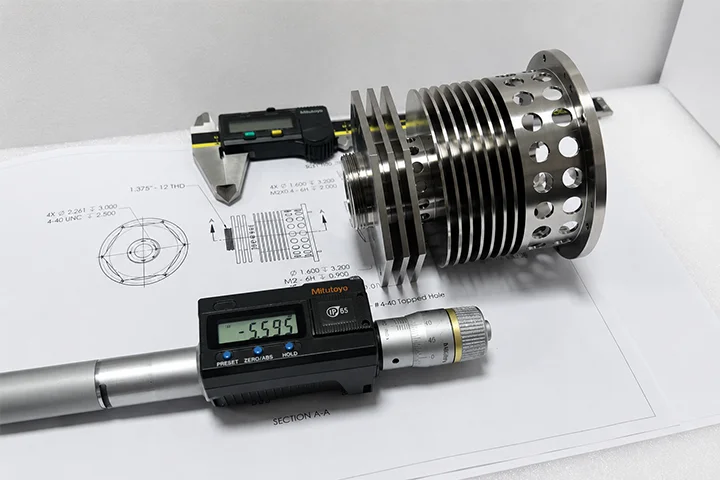
At this scale, calipers and hand gauges stop being useful — the features are too small, and the act of clamping a gauge onto a slender brass pin can deform the thing you are trying to measure. So the parts go under optical systems instead, including a Keyence image-dimension measurement system that captures the part profile and measures it without touching it at all.
Our optical measuring systems resolve to four decimal places in millimeters, which is what it takes to confirm features on parts like these with any confidence. Note the gloves, too: at this size, handling discipline is part of quality control, because a fingerprint or a nicked edge on a connector contact is a real defect, not a cosmetic one.
Which dimensions get measured, how often, and against what limits is set per project after drawing review — this walkthrough shows the capability, not a claim about a specific customer's specification.
06
Capacity Beyond a Single Machine

The current Swiss-type and sliding-headstock lineup has 13 machines: five Citizen R04VI units for miniature work, plus two each of the STAR SR-32JII Type B, STAR SB-20R Type N, Citizen Cincom L32 IX and Citizen Cincom A20VII. Together they extend the standard maximum machining diameter to Ø32 mm. Machine selection, minimum finished diameter, material and inspection requirements are reviewed against each drawing before production.