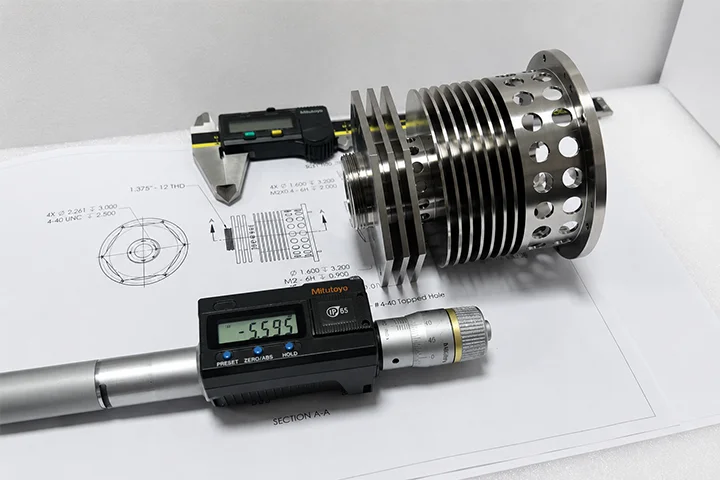

Aluminum and stainless steel can both produce accurate, durable CNC components, but they solve different engineering problems. The best choice comes from the full operating environment—not from strength or material price alone.
Choose aluminum when low mass, thermal conductivity, and machining efficiency lead. Choose stainless steel when corrosion resistance, stiffness, wear, temperature, or long-term durability justifies the added weight and processing effort.
01
Compare the performance the assembly needs
Aluminum offers a strong stiffness-to-weight balance and conducts heat well, making it useful for housings, fixtures, robotics structures, and heat-management components. Stainless steel is substantially denser, but its strength, hardness, temperature capability, and corrosion behavior suit demanding shafts, brackets, fluid components, and exposed hardware.
Material grade matters. OUJI machines aluminum 5083, 6061, 6082 and 7075; they do not offer the same strength or corrosion response. Availability of the required stock form, size and temper is checked for each quotation. On stainless, 303, 304, 316 and 316L differ in machinability and environmental resistance. Specify the grade only after identifying the property that drives the choice.
02
Understand the machining difference
Many aluminum alloys cut quickly and allow efficient material removal. Stainless steel generally requires more conservative cutting conditions, rigid workholding, and closer control of heat and tool wear. Deep pockets, thin walls, and small tools amplify that difference. On the same part design, we consistently see stainless steel take longer to machine and wear tools faster than aluminum, and stainless is more prone to distortion during machining — which is why workholding and cutting parameters need more conservative planning than the aluminum equivalent, not just a slower feed rate.
For either material, geometry can dominate cost. A compact stainless part with accessible features may be more economical than a large aluminum part that requires extensive material removal and multiple setups.
03
Consider the finished condition
Aluminum can be anodized, conversion coated, plated, painted, or powder coated. Stainless steel may be passivated, electropolished, bead blasted, brushed, or left as-machined. The surface treatment affects color, corrosion behavior, cleanability, conductivity, and critical fits.
A stainless component may need no added coating in an environment where carbon steel would. Aluminum may deliver lower mass but require anodizing and careful masking. Compare the complete finished-part route, not just raw stock price.
04
Five questions that make the choice clearer
Material selection becomes easier when the operating conditions are written down. If a requirement is uncertain, share the assembly context during RFQ review rather than locking the drawing to a grade too early.
- How important are component mass and system inertia?
- Will the part see moisture, chemicals, salt, or high temperature?
- Which loads, wear surfaces, or threads control service life?
- Does the part need thermal or electrical conductivity?
- What finish, appearance, and maintenance life are expected?